-Photoroom.avif)


Why Construction Projects Fail: 25 Common Causes and How to Reduce Risk
Explore 25 common causes of construction project failure across planning, scheduling, coordination, execution, and control—and how teams can reduce risk.


Construction projects rarely fail because of one single mistake. More often, failure is the result of many small gaps that compound over time: unclear scope, unrealistic schedules, poor coordination, weak cost control, late design changes, procurement delays, incomplete field information, low productivity, and delayed reporting. Industry sources repeatedly point to the same pattern: poor planning, communication breakdowns, scope creep, weak risk management, late changes, and poor coordination create cost overruns, delays, rework, and disputes.
The scale of the problem is massive across commercial construction. Research from Digital Construction Week shows that overruns, delays, quality issues, and inefficiencies remain common across major projects, and that these failure costs are often tied to planning, communication, coordination, supply chain, subcontractor, and design-change issues.
Below are 25 recurring reasons construction projects fail—organized across the five critical phases of project delivery—and what project teams can do to reduce the risk.
Phase 1: Preconstruction, Planning & Estimating
- Poor project planning and scope definition
Poor planning creates problems long before crews arrive on site. When the scope is unclear, teams make assumptions about responsibilities, deliverables, sequencing, tolerances, access, and trade interfaces. Those assumptions later turn into RFIs, change orders, rework, claims, and schedule pressure. Strong planning should define not only what must be built, but also how it will be coordinated, measured, approved, and handed over. Industry data specifically highlights the need to fully understand plans, specifications, scope of work, client expectations, milestones, risk strategy, logistics, and material/equipment planning before construction starts.
- Weak cost estimating and budget control
Cost failure often starts with optimistic assumptions. If the estimate does not reflect real field conditions, labor availability, productivity rates, procurement risk, escalation, logistics, and coordination complexity, the budget becomes fragile from the beginning. Weak cost control then turns small variances into major overruns because the team does not see the financial impact early enough. Industry analysis points to delays, budget overruns, quality issues, material waste, and rework as the major forms of construction failure costs.
- Inadequate risk and contingency planning
Risk planning is often treated as a document exercise instead of a live management process. Real project risks include labor shortages, delayed approvals, site constraints, design gaps, long-lead materials, subcontractor failure, weather, safety events, and change-order exposure. If the team does not assign ownership and mitigation actions, risks remain hidden until they become expensive problems. Unforeseen conditions can derail progress entirely if they are not planned for early.
- Sustainability targets added too late
Sustainability requirements affect materials, systems, documentation, procurement, waste management, energy performance, and handover data. When these requirements are added late, teams may need to redesign, substitute products, change suppliers, or recreate documentation. This can increase cost and delay while also creating confusion between design intent and field execution. Sustainability targets should be integrated early into scope, specifications, procurement, submittals, installation methods, and closeout requirements.
Phase 2: Scheduling, Supply Chain & Labor Capacity
- Unrealistic schedules and delivery pressure
An unrealistic schedule may look good during bidding or early project approval, but it creates operational pressure that usually appears later in the field. When durations are compressed without enough detail, crews are forced to overlap work, skip coordination, reduce quality checks, or start before drawings and approvals are ready. This creates a cycle where the schedule becomes less reliable the more aggressively the team tries to recover it. Unrealistic budgets and programs create pressure, defer decisions, compress stages, and increase the likelihood of error.
- Labor shortages and trade capacity gaps
Even a well-planned project can fail if the required trade capacity is not available when needed. Labor shortages affect productivity, sequencing, supervision, quality, safety, and subcontractor performance. When experienced workers are unavailable, teams often rely on less experienced crews, overtime, or resequencing, which can increase the risk of mistakes. Labor capacity should be treated as a planning constraint, not only as a procurement issue.
- Material price volatility and shortages
Material volatility can quickly break the connection between estimate, schedule, and actual delivery. Price increases affect margins, while shortages affect sequencing and crew utilization. If a key material is delayed, project teams may be forced to resequence work, store partial deliveries, or proceed with temporary solutions that create downstream rework. Strong procurement planning should identify long-lead items, alternate suppliers, substitution rules, and the schedule impact of delayed materials.
- Poor procurement lead-time control
Procurement is one of the most important links between design and field execution. If long-lead items are not identified early, the field schedule may become impossible even if crews are available. Mechanical equipment, electrical gear, specialty ceilings, doors, hardware, façade elements, anchors, embeds, and custom materials can all affect the critical path. Good procurement control connects submittals, approvals, release dates, manufacturing time, shipping, storage, and installation sequencing.
What could full-scale laser projection do for your next project?
Let’s find outPhase 3: Field Execution, Coordination & Quality
- Design changes after work begins
Design changes are one of the most disruptive causes of construction failure because they affect already-planned labor, material, procurement, sequencing, and trade coordination. A change that looks small on paper can affect layout, embeds, penetrations, framing, MEP routes, ceiling systems, access panels, sleeves, equipment clearances, and inspection timing. When changes happen after work begins, the team must manage not only the new design but also the impact on what has already been installed. Late design changes amplify cost overruns and spread disruption across multiple work packages.
- Poor site coordination across trades
Poor trade coordination is one of the most common reasons field productivity collapses. When framing, mechanical, electrical, plumbing, fire protection, ceilings, equipment, and finishes are not coordinated clearly, crews fight for space and resolve design conflicts in the field. This creates layout mistakes, clashes, delays, and rework. Research and industry commentary repeatedly identify poor coordination, fragmented information, and communication breakdowns as major contributors to project failure.
- Subcontractor performance issues
A project can fail even if the general contractor manages its own work well, because subcontractor performance affects the entire delivery chain. A delayed or underperforming subcontractor can block follow-on trades, create quality issues, and force other crews into inefficient workarounds. Performance issues may come from weak staffing, poor supervision, financial stress, unclear scope, late information, or unrealistic commitments made during bidding. Subcontractor selection should include capacity, past performance, supervision quality, safety culture, and the ability to coordinate digitally and operationally.
- Low productivity and rework cycles
Low productivity is not always caused by slow workers. It is often caused by poor work packaging, unclear drawings, missing materials, rework, access conflicts, repeated layout, unresolved RFIs, and waiting for other trades. Rework is especially damaging because it consumes labor twice: once to build incorrectly and again to correct it. Construction analysts consistently identify productivity issues and delays as core reasons construction projects fail.
- Incomplete BIM and digital coordination
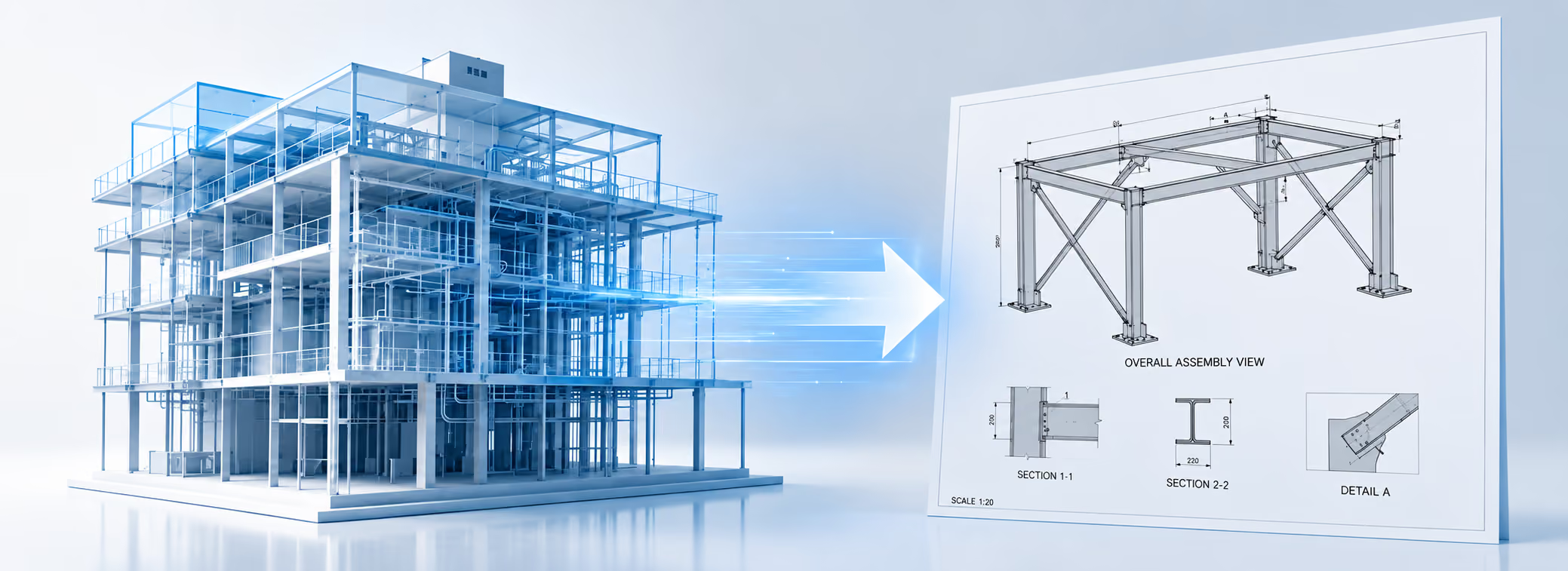
BIM can reduce coordination risk, but only when the model is complete, current, coordinated, and connected to field execution. If BIM is used only for design review but not carried into layout, installation planning, QA, and field verification, the project still suffers from a critical gap between the digital plan and what crews actually build. A complete BIM-to-Field workflow is required to fully solve the underlying coordination problem.
- Weak safety culture and field discipline
Poor safety culture is not only a health and compliance risk; it is also a project-performance risk. Unsafe practices lead to injuries, shutdowns, investigations, insurance exposure, morale issues, and loss of productivity. Schedule pressure often increases safety risk when crews are pushed to work faster, work out of sequence, or skip proper planning. Strong safety culture requires leadership, planning, training, supervision, and the discipline to stop work before small risks become serious incidents.
- Weak quality assurance on site
Quality problems are expensive because they often appear after work is covered, inspected, or depended on by other trades. Weak QA allows small deviations to become larger installation conflicts, failed inspections, punch-list items, and warranty issues. Rushing work to recover schedule can make this worse because crews may skip checks or rely on informal verification. Skipping quality checks almost always results in defects, rework, and disputes.
Phase 4: Project Management, Communication & Commercial Control
- Weak contract and claims management
Construction contracts define notice requirements, change procedures, schedule obligations, payment terms, risk allocation, and claim documentation. When site teams do not understand those requirements, they may perform extra work without proper authorization, miss notice deadlines, or fail to document delay impacts. This turns operational problems into legal and commercial disputes. Strong contract management does not mean being aggressive; it means keeping clean records, following agreed procedures, and protecting the project from avoidable confusion.
- Delayed approvals and permit bottlenecks
Delayed approvals can stop work even when labor and materials are ready. Permits, submittals, shop drawings, inspections, RFIs, and owner decisions all become schedule risks when they are not tracked and escalated early. Approval delays are especially damaging because they often create idle time, resequencing, and stacking of trades later in the schedule. A realistic schedule should include approval durations, review cycles, and decision deadlines—not just installation activities.
- Poor communication between stakeholders
Construction projects depend on constant communication between owners, designers, general contractors, subcontractors, suppliers, inspectors, and field crews. When communication breaks down, changes do not reach the right people, RFIs remain open, drawings are misunderstood, and crews work from outdated information. Communication failures directly lead to delays, accidents, costly rework, disputes, and unhappy clients.
- Cash-flow pressure on contractors
Cash-flow pressure can quietly destabilize a project. Contractors and subcontractors must pay labor, suppliers, equipment, insurance, and overhead before they always receive payment, especially when retainage, slow approvals, disputed change orders, or delayed invoices are involved. Financial pressure can reduce staffing, delay procurement, weaken supervision, and increase claims behavior. For project owners and GCs, monitoring subcontractor financial health is part of delivery risk management.
- Inaccurate progress reporting
Projects fail faster when leaders do not see reality early enough. If progress reporting is based on optimism, manual updates, delayed field input, or incomplete data, problems remain hidden until recovery becomes expensive. Accurate reporting should show actual installed work, constraints, open issues, productivity trends, rework, and schedule impact. Visibility into dependencies and project elements is critical to avoiding failure costs.
- Limited executive project visibility
Executives often receive high-level summaries that hide field-level problems. By the time issues reach senior leadership, the project may already be deep into delay, cost overrun, or dispute. Limited visibility makes it difficult to allocate resources, intervene early, support project managers, or reset expectations with owners and stakeholders. Strong executive visibility requires consistent reporting, clear risk escalation, and data that connects field progress to schedule, cost, quality, and commercial exposure.
- Over-reliance on manual tracking
Manual tracking is common in construction, but it creates risk when the project becomes too complex for spreadsheets, paper markups, whiteboards, and disconnected reports. Manual systems are slow to update, difficult to audit, and vulnerable to version-control errors. They also make it harder to connect drawings, field work, QA, progress, and handover data. Digital tools should not replace good management, but they can reduce the information gap between planning and execution when used consistently.
Your layout doesn’t stop at the floor. Project onto walls and ceilings, and adapt to as-built conditions.
Let’s talk about your projectPhase 5: Handover, Closeout & Continuous Improvement
- Poor handover and asset data readiness
Handover failure happens when project teams treat closeout as an administrative task instead of a deliverable that must be built throughout the project. Owners need accurate as-builts, O&M manuals, warranties, equipment data, asset tags, inspection records, and system documentation. If asset data is collected late, it is often incomplete, inconsistent, or disconnected from the actual installed work. A good handover process starts during planning and continues through procurement, installation, verification, and commissioning.
- Inadequate lessons-learned process
Many construction companies repeat the same mistakes because lessons learned are not captured in a structured way. Teams finish a difficult project, move immediately to the next one, and lose valuable knowledge about estimating errors, coordination gaps, vendor issues, design problems, and productivity assumptions. A good lessons-learned process should happen during the project, not only at the end, because waiting until closeout means many details are forgotten. Lessons learned should feed estimating, scheduling, procurement, BIM coordination, subcontractor selection, and field planning.
- No post-project performance review
A post-project review helps companies understand what actually happened compared with the plan. Without it, leadership may not know which assumptions were wrong, which subcontractors performed well, where rework occurred, which risks were missed, and which processes need improvement. This prevents continuous improvement and keeps project teams dependent on memory instead of data. A strong review should connect schedule, cost, quality, safety, productivity, change orders, claims, closeout, and client feedback.
The Bigger Pattern: Construction Projects Fail When Control Breaks Down
Looking across all 25 failure points, the pattern is clear. Projects fail when the delivery system loses control: scope becomes unclear, the schedule becomes unrealistic, design information changes late, procurement does not match the field sequence, subcontractors are not aligned, quality checks are skipped, and reporting does not show the real status early enough.
This is why project failure is usually systemic, not isolated. Common causes such as poor planning, unclear scope, poor coordination, unrealistic budgets, late design changes, weak risk management, and unclear responsibilities often overlap and amplify each other.
The best construction teams do not only react faster. They prevent more problems from reaching the field in the first place.
Bring Digital Layout Directly to the Jobsite
Not every construction failure can be solved by technology. A field tool will not fix a bad contract, unrealistic financing, poor leadership, or an owner decision that comes too late. But technology can eliminate the gap between the digital plan and the physical site—and that gap is where the majority of layout mistakes, coordination issues, productivity losses, and rework cycles begin.
This is exactly where LightYX and other field robotics supports project teams.
LightYX brings digital construction drawings directly onto the jobsite by projecting full-scale layout information onto floors, ceilings, and walls. Instead of relying on manual measurement, string lines, and repeated interpretation by each trade, crews see the layout precisely where the work happens. Through our scalable LightYX Access Subscription model, teams can effortlessly deploy this technology to support faster alignment between design intent and field execution.
How LightYX bridges the BIM-to-Field gap:
- Accelerate Field Readiness: Crews arrive to a fully projected, full-scale layout, immediately bypassing the wait times associated with interpreting drawings and pulling tape.
- Eliminate Trade Clashes: Project MEP, drywall framing, and ceiling layouts simultaneously so trades instantly see where their work belongs and resolve conflicts before installation.
- Eradicate Rework: By projecting layout directly from the coordinated BIM model, you strip out human measurement errors and manual interpretation.
- Multiply Layout Productivity: A single operator executes layout workflows in a fraction of the time, freeing up skilled labor for actual installation and accelerating the critical path.
- Enforce Model Accuracy: The digital plan is visible at full scale, exactly where the work happens, ensuring the physical site perfectly matches the coordinated model.
LightYX does not replace planning, procurement control, or project management. It fortifies them by ensuring the field execution layer is flawlessly aligned with the approved drawings.
Conclusion: Project Control Must Begin Before the Project is Under Pressure
Construction projects fail when risks are allowed to accumulate faster than teams can manage them. Poor planning leads to unclear scope. Unclear scope creates change. Change disrupts coordination. Poor coordination creates rework. Rework damages productivity. Weak reporting hides the problem until recovery becomes wildly expensive.
The lesson for construction leaders is simple: control must start early.
Successful projects need clear scope, realistic schedules, disciplined cost control, coordinated design, strong procurement planning, reliable subcontractors, accurate progress reporting, active risk management, and structured handover. They also need field execution tools that help crews build exactly what was planned—accurately, efficiently, and with zero room for misinterpretation.
That is the future of construction delivery: not just better plans, but a flawless connection between the plan and the site.
.avif)