-Photoroom.avif)


What Is BIM in Construction? A Complete Guide to Building Information Modeling
A practical guide to BIM in construction—from coordinated digital models and project management to reality capture, automated layout, and BIM-to-field execution.


Introduction: Why BIM Matters
Building Information Modeling (BIM) has become the defining technology and process reshaping the construction industry’s past, present, and future. From architects visualizing a concept to contractors executing field work and owners managing assets, BIM ties every phase of a built project together.
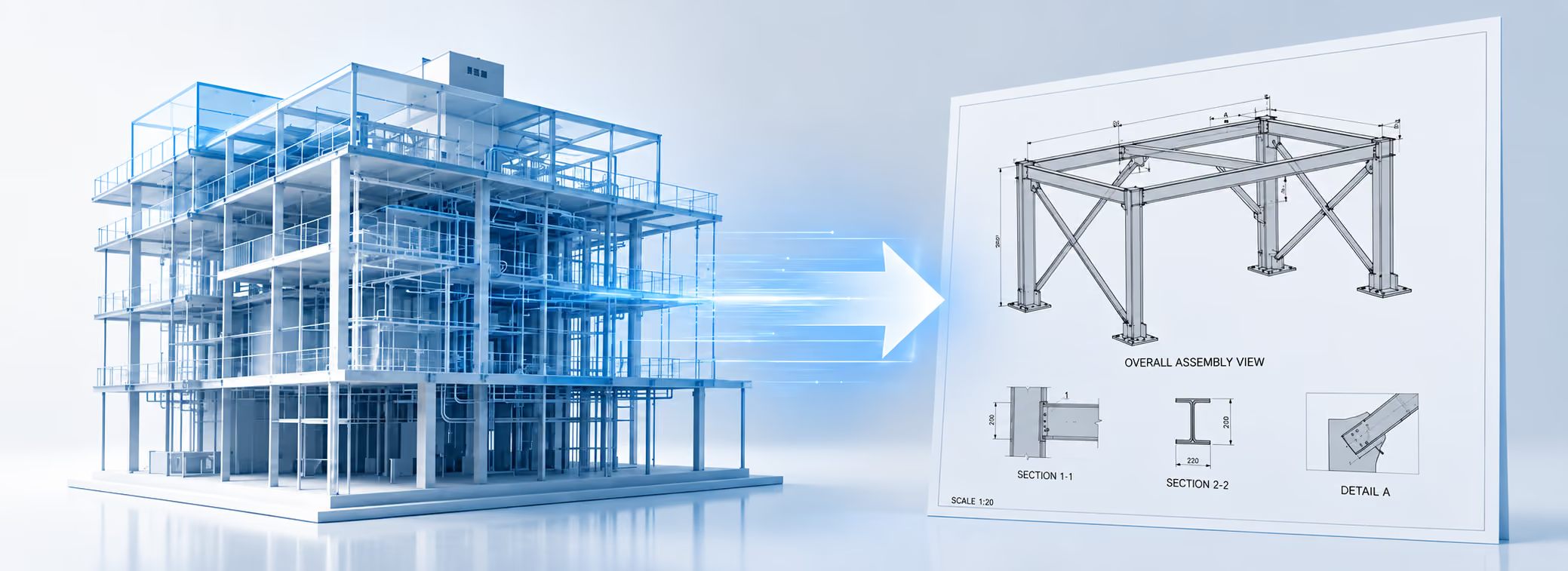
So what is BIM in construction? BIM is a digital representation of the physical and functional characteristics of a building or infrastructure — supported by tools, processes, and standards that allow multidisciplinary teams to collaborate around a centralized data model rather than disconnected drawings.
This guide covers what BIM is, how it's used in the construction industry, its benefits, and how BIM-to-field layout workflows are bringing digital models directly to jobsite execution.
1. What Building Information Modeling Actually Means
Building Information Modeling (BIM) is not simply 3D modeling. It is a holistic, data-centric process that integrates structured, multi-disciplinary information into a shared digital model that evolves over time from design through construction and into operations.
Unlike traditional drawings, which are static and separate from schedules, costs, or real-world context, BIM is a living dataset:
- It includes geometry and spatial relationships.
- It integrates metadata like schedules (4D), costs (5D), material quantities, performance metrics, and even sustainability data.
- It serves as a single source of truth for all stakeholders.
Because of this, BIM is a foundational technology for digital transformation in architecture, engineering, construction, and operations (AECO).
2. How BIM Is Used Across the Construction Industry
2.1 A Turning Point for Collaboration
Traditionally, construction projects have suffered from siloed information — architects use one set of plans, engineers another, and contractors build from paper or PDFs. BIM centralizes all data into a Common Data Environment (CDE) where every discipline can read, update, and validate the same model.
2.2 From Concept to Reality
In the construction industry today, BIM is used extensively to:
- Visualize complex project geometry.
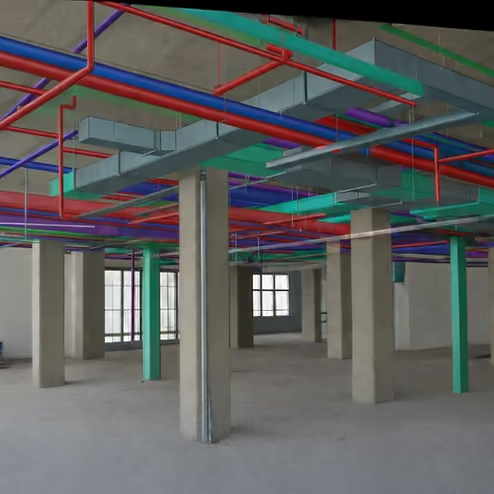
- Coordinate between architectural, structural, MEP, and specialty systems.
- Detect clashes before construction begins.
- Improve scheduling and sequencing.
- Drive quantity take-offs and cost estimation.
These capabilities reduce errors, reduce rework, and increase productivity — saving time and money on projects of all sizes. (Autodesk)For general contractors managing multi-trade coordination, BIM provides the centralized data environment that prevents the communication breakdowns that traditionally cause field conflicts and rework.
2.3 Support for Infrastructure and Beyond
BIM’s applicability isn’t limited to buildings; it’s also used for infrastructure projects like bridges, tunnels, earthworks, and geotechnical works, extending its value across the built environment.
3. BIM in Construction Project Management
BIM fundamentally changes how construction project managers plan and deliver work by integrating project controls — such as schedule, cost, risk, and quality — directly into the model.
3.1 Integrated Planning and Scheduling
With BIM, managers can visualize 4D sequencing (how tasks unfold over time) and simulate construction logistics, identifying bottlenecks before they impact the field.
3.2 Cost Management (5D BIM)
BIM allows project teams to connect model elements with cost information. This “5D BIM” capability supports more accurate budgeting, forecasting, and financial tracking throughout the project lifecycle.
3.3 Better Risk and Quality Management
Risk assessment and quality control are enhanced when all data is centralized and accessible, enabling proactive monitoring and enforcement of standards. Recent research highlights that BIM’s integration with project management processes improves efficiency when deployed throughout the project lifecycle.
What could full-scale laser projection do for your next project?
Let’s find out4. Benefits of Using BIM in Construction
The benefits of BIM in construction extend well beyond 3D visualization:
4.1 Enhanced Collaboration
A shared model means architects, engineers, and subcontractors no longer chase outdated information — they work from the same data set in real time.
4.2 Reduced Errors and Rework
Early clash detection and model validation help teams catch conflicts before they become costly field mistakes. (Autodesk)
4.3 Greater Efficiency and Productivity
By linking geometry with scheduling and cost, teams streamline workflows and reduce redundant work.
4.4 Better Decision-Making
Model-based analysis enables informed decisions about constructability, material selection, sequencing, and logistics.
4.5 Lifecycle Value
BIM models carry value through operations and maintenance, enabling better asset management long after construction ends.
5. BIM Technology Applications in Construction
BIM is applied in multiple ways across the industry:
- Design and visualization
- Construction coordination and clash detection
- Quantity take-offs and estimating
- 4D scheduling and 5D cost modeling
- Field access and model verification using digital layout tools that bring BIM precision to installation
- Facility operations and maintenance
This broad applicability makes BIM a versatile tool — from design offices to jobsite tablets.
6. What Is BIM Management?
BIM Management is the governance, standards, and oversight that ensure BIM delivers value across a project. A BIM manager sets up protocols, defines data standards, ensures compliance with industry norms (like ISO 19650), and oversees model quality.
Without effective BIM management, teams risk inconsistent model quality, data loss, or miscommunication — undermining the benefits of the technology.
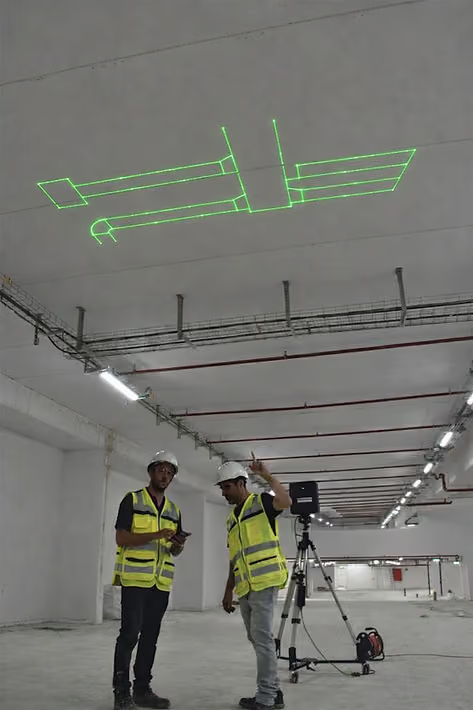
Your layout doesn’t stop at the floor. Project onto walls and ceilings, and adapt to as-built conditions.
Let’s talk about your project7. What Is a BIM Execution Plan (BEP)?
A BIM Execution Plan is a critical document that defines how BIM will be implemented on a specific project. It is created during preconstruction and serves as a roadmap for teams to:
- Establish project BIM goals.
- Define roles and responsibilities.
- Set modeling and data standards.
- Outline workflows and deliverables.
- Coordinate data exchange and communication protocols. (Trimble)
BEPs ensure all stakeholders know what to do, when to do it, and how to share information, preventing confusion during execution.
8. BIM-to-Field Execution: Bringing Digital Models to the Jobsite
BIM-to-Field refers to the process of taking BIM models — traditionally used in design and planning — and making them usable directly on the jobsite. Tools like mobile BIM viewers, automated layout hardware, and reality capture systems allow field crews to verify installed conditions against the digital model and translate coordinate-accurate BIM data into real-world construction actions.
- Access up-to-date models on tablets and phones.
- Verify installed conditions against the digital model.
- Translate coordinate-accurate BIM data into real-world construction actions.
This approach reduces layout errors, accelerates installations, and increases alignment between design and construction — closing the gap between office planning and field execution.
9. How Architects and Contractors Use BIM for Better Design
Architects and contractors use BIM collaboratively to:
- Explore design options with immersive visualization.
- Assess design performance using analysis tools.
- Incorporate constructability feedback early.
- Reduce design changes during construction.
This integrated mindset fosters better outcomes by aligning design intent with construction realities — reducing late revisions and enhancing project delivery.
User Research Links (provided) highlight how BIM enhances design coordination and helps teams deliver the built environment more predictably.
10. Future of BIM in Construction
The future of BIM is tied to several emerging innovations:
- AI and machine learning for predictive insights and automated model analysis.
- Internet of Things (IoT) and real-time data feeds to update models during construction.
- Robotics and automated layout to bring digital precision to physical execution.
- Digital twins that connect as-built conditions with real-world operation data.
These advancements will expand BIM’s role beyond documentation into dynamic, machine-assisted construction environments — making data actionable as-built intelligence.
Conclusion: BIM as the Backbone of Modern Construction
BIM has evolved from a modeling tool to a comprehensive digital methodology that drives collaboration, accuracy, and efficiency across the AECO industry. From construction project management to field execution, BIM connects stakeholders, compresses schedules, reduces risk, and improves outcomes.
Whether you're evaluating BIM for your next project or looking to strengthen your BIM-to-field execution, get in touch directly to discuss how LightYX brings digital precision to jobsite layout.
.avif)